


Energy
Designing homes to conserve energy and use it efficiently, from sources that cause least environmental harm.
Wind turbine systems
Wind turbine systems provide a source of renewable energy. They are most suited to windy rural locations.
On this page:
- wind generator system configuration
- wind generator system capacity
- wind speed and power
- cut-out controls
- factors affecting generation capacity
- wind generator system installation
- electricity supply connection
- wind generator pollution.
Under optimal conditions, the efficiency of a wind generator in converting energy to electricity is about 45%, although New Zealand research shows efficiency of 10–40% is more common in day-to-day operation.
Studies have found that average wind speeds in a particular location need to exceed at least 6–8 metres per second (m/s) for a small wind turbine to be economically viable.
When considering costs and economic viability, be aware that additional costs – consent costs, freight, the concrete foundations, wiring – can be the equivalent of 30–80 percent of the cost of the turbine itself.A turbine sized at 2kW could cost around $20–30,000 including installation. Maintenance costs should also be considered – wind turbines typically have higher maintenance requirements than, for example, photovoltaic systems. Some calculations have found that in many cases a solar electricity system is likely to be more cost-effective than a wind turbine. Figures from the Electricity Authority suggest that almost no residential or small-scale wind generators have been installed in recent years.
They are more suitable in remote locations as they can produce noise and may be regarded as unsightly.
Turbines may not perform well in urban areas because obstructions such as buildings tend to make the wind turbulent and erratic.
Wind generator system configuration
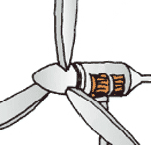
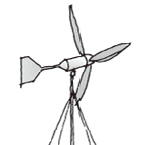
A wind turbine includes:
- turbine blades – propellers with two, three or five blades mounted on the horizontal shaft (this gives higher output than when they are mounted on the vertical shaft) and made of a lightweight material such as carbon fibre, fibreglass or wood, that is strong enough to resist wind forces.
- a tail section – generally a fin that rotates the body of the wind generator to turn the turbine into the direction of the wind, with the fin directly downwind
- an alternator – AC electricity is generated by rotor windings connected to the shaft from the turbine
- a rectifier – converts AC to DC for electricity that is being sent to a battery storage system (the rectifier may be located in the alternator or in a separate control box away from the tower)
- electricity cables – transfer the electricity from the generator to the electricity supply or battery storage system
- slip rings – stop the cables twisting as they will otherwise twist within the tower as the turbine body rotates
- electric element – power is always produced when the turbine spins, so if the power is excess to storage capacity, it must be redirected to a dummy load (generally an electric element that gets very hot) or sold (if permitted under the district plan) to an electricity retailer
- tower – the structure (usually steel, concrete or wood) that holds the turbine high in the air, and allows the turbine assembly on top to rotate into the wind – for residential applications, it is typically a mast pole with guy wires
- guy wires – hold the mast pole in operating position
- gin pole and winch – allow the turbine to be lowered for maintenance
- concrete foundation – a 2–3 kW turbine on a 10–15 m tower will typically require a 3–5 m3 reinforced concrete foundation.
Wind generator system capacity
Wind generators are commonly rated at 1–3kW. This will typically provide one-third to one-half of the power needs of a residence, depending on the local wind conditions and the house’s power consumption. In an exposed location, this size of generator can supply all power needs and provide a surplus. Bigger wind generators are available for farms and rural communities. The turbines’ actual energy output is typically about 25% to 30% of its rated theoretical maximum output. The output of a wind generator will normally be rated at a specified wind speed, and the rated wind speed may vary between systems and manufacturers.
The electricity generation capacity of wind generator systems is directly proportional to the amount of usable wind, which is itself a function of wind speed and cleanliness.
Wind speed and power
The wind power density is the number of watts of electrical energy produced per square metre of air space (W/m²). This value is normally given at 10 m or 50 m above the ground.
In general, the available wind generation capacity is determined by the average wind speed over the year for each location. Around New Zealand, the average wind speed is typically greater in regions:
- along the coasts between the North and South Islands
- in the mountain ranges and immediately east of them
- towards the tops of ridges or the heads of valleys.
With large turbines, increases in wind speed lead to considerably larger increases in energy output – when the wind speed doubles, the energy produced can increase up to eight times. However, New Zealand studies with small domestic turbines have found the increase is usually more linear – when wind speed doubles, the energy produced doubles.
Wind speed fluctuates, which has an impact on wind electricity generation capacity and operating characteristics. In general, wind speeds are as follows:
- 8 kph (2 m/s) minimum is required to start rotating most small wind turbines.
- 12.6 kph (3.5 m/s) is the typical cut-in speed, when a small turbine starts generating power.
- 36–54 kph (10–15 m/s) produces maximum generation power.
- At 90 kph (25 m/s) maximum, the turbine is stopped or braked (cut-out speed).
The wind power at a site can be obtained by a measurement device mounted on a pole at the height of the future wind generator. Collecting data for a whole year is not generally viable, so a couple of months of data can be taken and compared with data from a local weather station and then extrapolated for the year. Devices include:
- an anemometer – giving average daily wind speed
- a wind totaliser – giving instantaneous wind speed and total wind over an extended period.
Cut-out controls
Cut-out control options are available that:
- apply a brake to stop the turbine completely and feather the blades (reduce their angle to the wind) to turn it to face away from the wind
- tilt back or lie down the turbine (this is known as ‘tilt-up governing’)
- steer the turbine out of the wind through aerodynamics and gravity (this is known as ‘autofurl’)
- govern the rotational speed with an air brake to produce constant power
- feather the blades (reduce their angle to the wind) to reduce turbine speed.
Factors affecting generation capacity
A system’s generation capacity depends on its effectiveness at converting wind pressure into turbine rotary inertia – data should be available from the system supplier. This increases with:
- larger turbine diameter – there is more turbine blade area for the wind to impact on and also greater risk of intrusive noise
- appropriate blade profile for the local wind speed – this varies depending on average wind speed and also on whether the wind is constant or comes in short periods of high velocity
- lower friction losses in the turbine shaft assembly.
Generation capacity will decrease if the turbine is located:
- lower to the ground – wind speed increases with height above the ground, with a minimum of 10 metres recommended
- within the turbulent airspace downwind of an obstacle (for example, trees, hills, buildings, structures) – downwind turbulence will extend to twice the obstacle height for a distance around 20 times the obstacle height
- a distance from an upwind obstacle of more than 10 times an obstacles height.
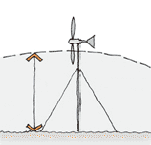
- Siting of a wind turbine
Wind turbines work best when a turbulence-free airflow is available to power the turbine blades.
Wind generator system installation
A wind generator system:
- will require a building consent and a resource consent
- should be installed within 100 m of the electricity supply or storage system, to reduce line losses
- must withstand the wind and seismic loads
- usually has a concrete footing for the tower (and each guy wire)
- must have vibrations in the tower (from turbine rotating forces) dampened if it is connected to a building
- must have protection from large animals at ground level – they like scratching themselves on the tower and guy wires
- should have lightning arresters to protect electronic components from lightning strikes
- needs sufficient area to lower and raise the tower for maintenance and repairs.
Meeting electricity demand
Electrical power from the wind generator system may be available at all times of the day, but the output levels will vary according to wind speed. Excess output, generated as AC, is converted to DC by a rectifier for storage in batteries. This will allow for peak demand that is greater than the generator capacity.
Very small turbines are unlikely to meet total household demand for energy. Using a solid fuel burner for space heating and solar panels for water heating will help reduce demand for electricity, but for systems that are not grid-connected, a diesel generator may still be required sometimes.
Wind generator pollution
Wind generators can produce noise and vibration and have a visual impact. Noise can be from the turbine blades, gearbox (if used) and brush gear, as well as from wind moving past the tower and guy wires. Noise and the visual impact may be an issue with neighbours, and vibration may be a problem particularly if a turbine is located on a roof.
These factors should influence decisions about the wind generator location, size and height.
More information
Updated: 19 December 2025