


Other Resources
Providing independent information and links to guidelines and tools to help design and construct sustainable buildings.
Energy Performance Tools
A number of New Zealand-focused energy performance and design tools are available to help you design energy efficient buildings and assess their performance.
H1 Calculation method tools
This BRANZ tool checks for compliance of housing and small buildings with the calculation method of H1/AS1 5th edition amendment 1. Inputs are added on separate sheets and a results page is automatically generated, which can be submitted with building consent applications.
The NZ Green Building Council (NZGBC) also has an online H1 calculator for the calculation method.
Carbon calculators/tools
BRANZ has two life cycle assessment tools (LCAQuick and LCAPlay) and two carbon footprinting tool CO2RE and CO2MPARE.
The National Embodied Carbon Data Repository (NECO2) provides free public access to embodied carbon data on thousands of New Zealand construction materials. When paired with tools such as BRANZ’s LCAQuick, NECO2 enables architects, designers and engineers to compare the carbon footprints of materials and make smarter environmental choices early in the design process.
Toitū Envirocare (a subsidiary of Manaaki Whenua – Landcare Research, a Government-owned Crown Research Institute) provides information on independent carbon audits and third-party certification. Its carbonzero and carbonreduce certification programmes are accredited by the Joint Accreditation System of Australia and New Zealand (JAS-ANZ) and were the world’s first carbon certification programme to be accredited under ISO 14065.
NZGBC has an online tool for calculating the energy and carbon emissions of New Zealand homes, ECCHO (Energy and Carbon Calculator for Homes).
Photovoltaic generation calculators
A household can generate its own electricity from sunlight with a photovoltaic system on the roof. The Toolbox on the BRANZ website has a photovoltaic generation calculator that can tell you how much electricity a PV system can produce. Just enter a few facts about the size of system, whether it is flat or inclined, how far away from facing north it is and so on, and at the click of a button, you can find out how much power you can expect it to generate.
Other useful online calculators for photovoltaic generation in New Zealand include the EECA Solar Power Calculator. The EECA website also has rooftop solar in its home energy savings calculator, indicating how solar could reduce household energy use and long-term costs. SEANZ, the Sustainable Energy Association of New Zealand, has the SEANZ Solar Optimiser tool.
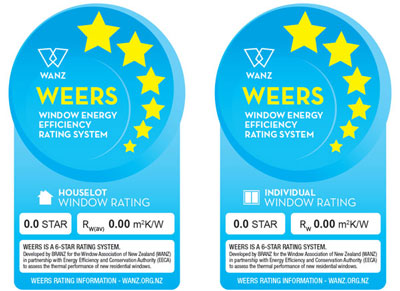
Window Energy Efficiency Rating System (WEERS)
The design and installation of windows has a major impact on a building's energy efficiency with up to 40% of heat loss being through glass. Windows affect how much energy buildings use, how warm or cold they are and how comfortable they are for the occupants.
When replacing glazing, one tool that can help is the Window Energy Efficiency Rating System (WEERS), a 6-star rating system. WEERS combines the thermal performance of the frame and glazing, together with the size
of the window, to calculate an individual thermal performance rating RW for each window.
Thermal simulation tools
Simulation software can measure the impact that design decisions are likely to have on the thermal performance of a building. They can guide a designer to the optimal passive design for a project. Some of the main international software tools available are discussed on the thermal simulation page.
Updated: 30 November 2025